31 January 2018

News and a Narrowboat

On 1 September 1939, Tom Rolt and his wife Angela were travelling along the Trent and Mersey canal aboard their narrowboat, Cressy. Arriving at Trentham Bridge to take on some fuel they were hailed by a boatman at the tiller of a passing barge, who told them that Germany had invaded Poland. That day they passed through the Potteries, and the Harecastle Tunnel on into Cheshire, where two days later they heard the announcement that war had been declared.

Rolt, a future campaigner for preservation of Britain's neglected canal system and one of the founders of the Inland Waterways Association, later wrote a lyrical account of their journey entitled Narrow Boat, which sparked a post-war resurgence of interest in this by-then woefully neglected transport network. A traditionalist at heart, Rolt was dismissive of many of the towns and cities they passed through, but devoted two short chapters to their brief passage through the Potteries. His appreciation of the area and its people stemmed from the fact that he had some years earlier partially served his engineering apprenticeship at Messrs Kerr, Stuart and Co, locomotive engineers in Stoke.

Reference: L.T.C. Rolt, Narrow Boat pp. 115-129; Landscape With Canals, p.3.

26 January 2018

Hannah Dale - The Child of Wonder.

A wildly exaggerated publicity image of Hannah Dale c.1889.
Author's collection.

Hannah Dale, 'the Staffordshire Giantess' as she became known, was born in in the village of Mow Cop on the 23rd February 1881. She was the daughter of 31 year old miner Thomas Dale and 28 year old Elizabeth Dale, nee Oakes of Dales Green, Mow Cop, and was their fourth child, Hannah having a brother and two sisters older than herselfAll the family were normal average-sized folk, her father weighed 10 stone, and her mother was only 8 stone in weight and their other children were likewise quite ordinary. At the time of her birth Hannah too seemed to be a normal child, so small it was said that she could fit into a quart jug, but at the end of three months she began to develop very rapidly and this growth continued throughout her short life. Within a few years she had outstripped her older siblings in weight, and though she started out enjoying a perfectly normal childhood Hannah was growing taller and broader and soon became something of an attraction in the out-of-the-way village.

It is unclear when Hannah's parent's first started exhibiting their rapidly expanding child to a paying public, but she was certainly something of an attraction for the crowds when at the age of eight flyers such as the one seen here were advertising her for exhibition. Though depicted on the flyer as a veritable giant, Hannah was at this time actually only 4ft 4ins tall, but weight-wise she was prodigious, already weighing more than most grown men, so big that the family home at Oakes Bank, Dales Green had to have the doors widened. By the time she reached ten years of age, Hannah had grown to 4ft 11ins tall, had a 55-inch chest and her thighs measured 3ft around while the vaccination marks on her arms had stretched out to the size of small plates. Looking at her it was easy to forget that she was so young, but many papers were happy to point out that she was still very much a child, at her happiest playing with the other children in and around Mow Cop.

'She is a bright, attractive, and talkative child, and plays as other children do of her own age. For her enormous weight she is very active, but if she accidentally stumbles and falls she cannot get up without assistance. Dolls are her great delight, and in making their apparel she exhibits considerable dexterity and intelligence... She has no special diet, but dines with the other members of the family, consuming as much food as a healthy man, and sleeping on an average twelve to fourteen hours each night. On the railway she travels with a half-ticket, a privilege to which she is entitled, but which often causes her father to supply his name and address to irate ticket collectors, who entertain an honest suspicion about a giantess who takes up as much space as three ordinary persons would occupy.'

South Wales Echo, 16 June 1892, p.2


For several years Hannah was exhibited around the country and by 1892 was becoming something of a celebrity. Early that year she was fulfilling an engagement at Sheffield, prior to going to America, but her fame was cut short when she fell ill with bronchitis in late May or early June of 1892. Her condition quickly worsened and she was taken home to recuperate, arriving there on Tuesday 7 June. However, it was too late and she died from the infection the next day.

At the time of her death, Hannah Dale, was 5ft 3ins tall, weighed 32st 6½lbs, and measured 5ft. 8in around the waist. Her size caused difficulties when it came to her funeral at St Thomas Church, Mow Cop, on 10 June. Her coffin was huge, its size demonstrated prior to her funeral by the undertaker, a Mr Boon, having five young men lying down sideways in it and easily closing the lid over them. Together with the corpse, this finally weighed 6cwt, (48 stone, or nearly 305 Kg) and took up a double plot. It required thirteen people to carry and then lower the little girl's coffin into the grave.

Nearly 2,000 people, many of them friends and neighbours and other locals who had watched Hannah grow up assembled to witness the funeral. The inscription on her gravestone read:


IN LOVING MEMORY OF 
HANNAH
The beloved daughter of
THOMAS & ELIZABETH DALE
Of Dales Green Mow Cop
WHO DIED JUNE 2ND (sic) 1892
AGED 11 years & 3 months.
HERE LIES MY DUST THE CHILD OF WONDER
I BID FAREWELL TO ALL BEHIND
AND NOW I DWELL JUST OVER YONDER
IN HEAVEN WITH GOD SO GOOD AND KIND
ALSO WILLIAM & WALTER their sons
WHO DIED IN INFANCY


Reference: Philip R. Leese, Mow Cop: Living on the Hill; Staffordshire Sentinel, 11 June; South Wales Echo, 16 & 22 June 1892; Daily Gazette for Middlesbrough, 22 June 1892, p.4; Hampshire Advertiser, 16 July 1892, p.7.

24 January 2018

Captain Smith Tells a Tale

Hanley-born Commander Edward John Smith is best remembered as the captain of the ill-fated White Star Line steamer RMS Titanic, which sank on its maiden transatlantic voyage after colliding with an iceberg in 1912. In many ways the image of Smith presented in the disaster has coloured how we see the man, to some he is the villain of the piece, to others a tragic figure. The few earlier glimpses that exist though, paint Captain Smith in a far different light. For instance in 1911 following the successful maiden voyage of Titanic's elder sister Olympic, Smith comes across as something of a raconteur, playfully spinning a yarn to deflect over- eager reporters.

Captain E. J. Smith
Author's Collection

'Captain Smith of the Olympic was questioned in New York about the coal consumption of the world's biggest liner on her first voyage. But Captain Smith shook his head and said:

"That is a coal story I am not privileged to speak about. I'll tell you another coal story, though, if you'd care to hear it?"

"I'd be delighted," said the reporter. "Well," said Captain Smith, "It's a story about a poor sailor. He was taken down with fever on a brigantine. and, though the mate and captain dosed him well, he died. They buried him at sea. "They buried him with the usual impressive sea rites. He was sewed in a sail round which a flag was draped, and, to make him sink, the sail was weighted with a number of big lumps of coal. "A landlubber of a passenger participated in the services. He watched the well weighted corpse slip into the water. It disappeared at once, and the landlubber shook his head and said: " 'Well, I've seen many a man go below, but this is the first one I've seen taking his own coal down with him.' "

San Francisco Call, 29 August 1911 

23 January 2018

The Curious Case of the Dwarf and the Bulldog.

Brummy and Physic battle it out.
Low Life Deeps.
In a detailed and lurid article published on 6 July 1874 in the Daily Telegraph, investigative journalist James Greenwood claimed that several days earlier on 24 June, during a brief stopover in the Potteries, where he hoped to find evidence of illegal organised dog fighting, he and a large crowd of onlookers had instead witnessed a brutal fight in a cellar in Shelton between a grizzled, muscular dwarf named Brummy and a ferocious bulldog named Physic, a battle that the man had barely won. The national scandal that resulted from this shocking article seriously embarrassed the area for a time and questions were even asked in Parliament. 

However, all was not quite as it seemed and once the initial furore had died down the tables were  quickly turned on Mr Greenwood, as subsequent investigations by the police, the local authority, other newspapers and the RSPCA, not only highlighted the numerous glaring discrepancies in Greenwood's tale, but more tellingly found no absolutely evidence whatsoever that such a fight had taken place. Rather than sticking rigidly to the story he had spun, Greenwood then started to back-peddle, changing or mitigating parts of the tale to excuse himself and explain why there was no proof to be found, all of which excited a great deal of derision from other papers. The upshot of it all was that within a few weeks it was widely concluded that Greenwood had simply made the story up, or adapted a dubious scrap of Staffordshire folklore that he may have heard during his stay in the area. Following the RSPCA’s investigation and the report they sent in to the government, the Home Secretary of the time came to the same conclusion and on 20 July wrote a reply to the Hanley Watch Committee, which stated that he was satisfied that the story of the fight was false. 

Greenwood had thus been called a liar at the highest level and Hanley’s good name was restored, but mud sticks, and the tale rankled with the people of the Potteries for a good while after. In 1907, Arnold Bennett summed up the lingering ill-will towards the reporter and his tall tale in his famous short story ‘The Death of Simon Fuge’. 

‘The only man who stands a chance of getting his teeth knocked down his throat here is the ingenious person who started the celebrated legend of the man-and-dog fight at Hanbridge. It's a long time ago, a very long time ago; but his grey hairs wont save him from horrible tortures if we catch him. We don't mind being called immoral, we're above a bit flattered when London newspapers come out with shocking details of debauchery in the Five Towns, but we pride ourselves on our manners.’ 

Reference: James Greenwood, Low Life Deeps; Staffordshire Sentinel, July 1874; numerous national newspapers and magazines July 1874.

22 January 2018

Last Stand at Isandlwana

The Battle of Isandhlwana by Charles Edwin Fripp


On 22 January 1879, a British force of over 1,300 men, mostly from the 24th Regiment of Foot, was surprised and destroyed by a massive Zulu army at the Battle of Isandlwana ('Isandula' in some early accounts) in present-day South Africa. It seems that at least three local men, Private William Henry Hickin from Hanley, Private George Glass from Shelton and Sergeant William Shaw from Tunstall  were killed in the battle. 


Private McNally's Letter

Another local man, Private John McNally of C Company 2/24th Foot was part of a detached force that returned to the deserted battlefield that evening and he later penned a letter to his parents in Hanley describing the scene that met their eyes.

                                                                                                  'Rorke's Drift, February 2nd 1879.'
'Dear Father and Mother,
I received your last letter all right, and was sorry to hear how things were going on at home. I should have written before but we have been so put about that we could not get any writing paper, having been continually on the march. We have had a great drawback since we came in Zululand. On the 22nd of January, while we were out searching for the Zulus, our camp was attacked, and the 1st battalion 24th regiment were all slaughtered, except about six, who escaped. We* lost 134 men, our colours, and our kits. Our tents were destroyed, our ammunition stolen, our rifles broken and taken off. Our hospital waggons were torn to pieces, the sick killed, the medicine bottles all broken, bags of flour and meal - in fact, everything - destroyed. It was a horrid sight for us. When we returned at night in the dark, we had to charge our way to camp with our bayonets. We were falling in holes and over anthills, and in camp we were falling over the dead bodies of our comrades, who had been killed, and awful as it is to relate, it is true - they were cut right down the chest and across their bellies, their bowels coming out. Some had their toes, some their ears, others their arms cut off, and some in fact - dear mother and father, I cannot describe the horrible treatment they had to suffer. The little band boys were tied to a waggon and their flesh stripped off them. We had our company, B. Co., staying here** to guard our stores. The Zulus came upon them and tried to take possession of our stores, but they were repulsed, our side losing about 12 men, the enemy about 900 or a thousand. We numbered about 100; the enemy numbered about 5,000 or 6,000. But although we have suffered this loss, we hope, please God, to have our revenge when we get some more troops out from England. We have been twelve days and have never taken our boots off, always watching day and night for the enemy making an attack, which they generally do at night. Tell McDermott that lives in Weaver-street, to write to his brother in Wolverhampton, and tell him that his son James has been killed. He went sick the morning our camp was attacked. If McDermott likes he can write to the commanding officer of his regiment, and he will give him every satisfaction respecting him.'

Staffordshire Sentinel, 26 March 1879.

*   McNally's own battalion the 2/24th.
** Rorke's Drift, McNally refers here to the famous battle depicted in the film Zulu.


747 Private William Henry Hickin, 1/24th

The memorial window to Private Hickin
in St Johns Church, Hanley.
William Henry Hickin was born in Hanley in early 1854, the eldest child and only son of Henry Hickin and his wife Hannah nee Dobson. William had an elder sister named Prudence and two younger sisters Annie Elizabeth and Mary. His father Henry came originally from Macclesfield in Cheshire, but having moved to the Potteries early in his life on 12 November 1849 he married Hannah Dobson in Wolstanton and worked locally as a locksmith and bell hanger. In 1861 he and his family lived at 13 Windmill Street and 7 year old William and his sisters are listed as 'scholars'. Ten years later the family had moved to 8 High Street, Hanley and 17 year old William worked as a 'Writing Clerk'. It seems, though that William wanted more excitement in his life and on 5 January 1876, he enlisted in the 1st Battalion 24th Regiment of Foot as Private 25B/747. 

Perhaps for William Hickin, the prospect of all-male company offered by the army had been a major factor in him joining up, as in late September 1876, Private W. Hicken (sic) 24th Foot, appeared before a court martial at Dover accused of being drunk and committing an ’Unnatural offence’. The next day one Private Thomas Dickinson also of the 24th Foot was accused of ‘Drunk. Permitting Pte. to commit unnatural offence on him.’* At a time when homosexual acts could get men sentenced to life imprisonment, the court’s sentence of 7 days hard labour for both of them seems extremely lenient, even more unusual is that the sentence was later remitted. Perhaps the court decided that the evidence was weak, or if not that rather than impose a severe sentence, they would give both of them a warning shot across the bow to prevent any future incidents. Or maybe they simply considered that the two soldiers had been so drunk they didn’t know what they were doing. Whatever the case that seems to have been the end of the matter. 

*WO86/25 Judge Advocate General’s Office, Courts Martial Registers pp.307-308.

Over a year and a half of training and home duty passed before Hickin went to join the 1/24th in South Africa on 22 August 1877. He was immediately engaged in the Kaffir War against the Gaikas, Galekas and other tribes during 1877 and 1878. Then in 1879 like the rest of the 24th Foot he was engaged in the opening moves of the Zulu War. Advancing into Zululand with the central column he was one of the soldiers who fought and were killed at Isandlwana on 22 January 1879.

His remains like those of the rest of the regiment were buried on the battlefield some months later and his effects and campaign medal were passed on to his father. Back in Hanley William Henry Hickin was not forgotten. He was commemorated on his grandfather's gravestone in Hanley Cemetery and his family had a memorial window installed in St John's Church, Hanley.


'HANLEY.'

'MEMORIAL WINDOW.- A few days ago a handsome stained window was placed near the south door in the Old Church, in memory of William Henry Hickin, a private in the 24th Regiment, who was killed in the now famous battle of Isandula. The deceased was twenty-five years of age at the time of his death, and when in this district was in the habit of regularly attending the services at St. John's Church; his father Mr. H. Hickin having been a churchwarden for several years past. The expense incurred has been defrayed by subscriptions raised amongst the congregation. The subject dealt with is a very artistic treatment of the legend of St. George and the Dragon. The inscription is as follows:- “To the glory of God, and in memory of William Henry Hickin, of the 24th Regiment, who fell in the Zulu war, at the battle of Isandula, in South Africa."'
                       
Staffordshire Sentinel 11 December 1880


According to local Zulu War researcher Ken Ray, Private Hickin was the only 'other ranks' casualty of the battle of Isandlwana to be commemorated with a stained glass window. He also informs me that Hickin's campaign medal which was for many years held by a collector outside of the area is now in the hands of a local medal collector.


408 Private George Glass, 1/24th

'Death on the Battle Field. - The following names appear in the official list of those who fell at lsandula: Private Plant, Shelton, of the 1st battalion of the 24th Regiment; Private W. Glass, 1-24th Regiment, of Cauldon-place, formerly schoolmaster of the Hanley and Shelton Free Night School; and Private Hickin, 1-24th Regiment, son of Mr. Hickin, locksmith, High-street.'

Staffordshire Sentinel and Commercial & General Advertiser - Saturday 08 March 1879, p.5

George Glass was born in Newcastle-under-Lyme, Staffordshire in 1856, the youngest son and penultimate child of William and Martha Glass. His family had strong military ties in that his father William, hailed from Armagh, Northern Ireland and in 1822 had joined the ranks of the 1st Battalion of the 1st Regiment of Foot, serving 22 years with the regiment. William married whilst in the army, his wife, George's mother Martha came originally from Scotland. Together they had nine children, the eldest born in Ireland, but most were born in the Potteries or Newcastle after the couple had moved there in the 1840s when William Glass left the army. Here in both 1851 and 1861 he listed his employment as as a 'Staff Sergeant of Pensioners (Chelsea Pensioners)'.

George's mother Martha died in 1862, which doubtless prompted his father to find a job and by 1871 William Glass was working as a bookkeeper. He had moved the family to Hanley and had remarried, this time to a woman named Susannah from Newport, Salop. At 14 years of age his son George was now old enough to go to work and was employed as a potter. There is no further local documentation about George and though it is not impossible that he worked as a school teacher as noted in brief notification in the Sentinel, it seems more likely that the reporter was actually confusing George with his father. Not only is the dead soldier mistakenly listed as 'W. Glass' in the paper, but in the 1881 census William Glass describes himself as a former school master.

George had joined the army in Liverpool on 28 July 1874 becoming 25B/408 Private George Glass of the 1st battalion 24th Regiment of Foot, aged 18 years 4 months. Like most of the 1/24th he took part in the campaigns against the Gaika and Galeka tribes during 1877 and 1878 and marched into Zululand with the ill-fated centre column in 1879, being killed with most of his battalion at Isandlwana. George's effects and South Africa Medal were later claimed by his father.

Reference: Norman Holme, The Silver Wreath, p.26


2236 Sergeant William Shaw, 2/24th

Staffordshire Sentinel and Commercial & General Advertiser - Saturday 8 March 1879, p.5


William Shaw was born in Tunstall in 1846, the son of potter Aaron Shaw and Sarah nee Hicks. He appears from the 1841 census to have had an elder sister named Elizabeth while other documents reveal a younger sister named Mary Ann, but fuller details of William's family are complicated by the apparent lack of an entry in the 1851 census that may have revealed more siblings. By the time of the 1861 census, William's father was dead and his mother had remarried, this time to collier John Whalley and William and his sister Mary Ann are listed as his step children at his home in Watergate Street, Tunstall. William was 15 years old at the time and his profession was given as an 'apprentice potter'.

We next hear of William Shaw five years later at his wedding after banns to local farmer's daughter Emma Worrall at Christ Church, Tunstall on 18th June 1866. Both were 20 years old. William worked as a potter, but signed his name with a fairly practised hand, revealing at least a basic education, while his bride had to sign her mark.

What prompted William to join the army is unknown, but from the available evidence he appears to have enlisted in the spring of 1870 along with a number of Potteries youths if the newspaper report above is to be believed. His service number is given as 2-24/2336 in some muster rolls but was actually 2-24/2236. He was posted to the 2/24th in Secunderabad, India on 28th December 1870. He was promoted to Corporal on 22nd January 1873 and Sergeant on 8th April 1877. However, two years prior to this last promotion the Judge Advocate General's Office: District Courts Martial Registers (1875-1876) have a Sergeant William Shaw, 24th tried by court-martial 20 October, 1875 at Dover.  He was charged with “Theft” and sentenced to 84 days imprisonment with hard labour, and to be “Reduced.”  A notation shows that the sentence was “Not Confirmed.”

Certainly during the early part of his career, William Shaw was separated from his family and in 1871, his wife Emma and their two eldest children Mary Ann and William Henry Shaw aged 2 and 1 years respectively, were lodging with William's mother and step father at their home in King Street, Tunstall. Only a limited number of wives and children were allowed to accompany battalions when they went abroad and it seems that rank finally told and having raised himself to sergeant, William got permission for his wife and children to join him, first at Aldershot where a third child Sarah was born on 1875 and two years later a last child for the couple, John, was born in Kent in 1877, shortly before the battalion was posted to the Cape. In South Africa as the newspaper report on his death indicates, the family were based in King William's Town, Cape Colony.

Sergeant Shaw saw service against the Galeka tribe in 1878 and at the opening of the campaign against the Zulus in 1879 he was listed as serving in H Company 2/24th, however accounts of the battle have him variously serving in C Company (which apart from a few men left in camp, did not take part in the battle) or G Company. Though entitled to the South Africa Medal and Clasp ‘1877-8-9’, a notation on the medal roll says that there was “no trace of issue” of his medal.

According to the notebook of Corporal John Bassage 2/24th, now held at the Royal Welsh regimental museum, who was part of the force come to bury the dead in June 1879, the remains of Sergeant Shaw and three private soldiers were found together in a heap on the battlefield. The men seem to have formed a small group in a last desperate attempt to try and fend off the Zulus in front of them. All four appeared to have been stabbed to death with assegais. 

Following the death of her husband, Emma Shaw returned to Britain with her children. Due to the family's now straightened circumstances, the three older children Mary Ann, William and Sarah were sent to the respective Royal Victoria Patriotic Asylums for Boys and Girls in Wandsworth, the two institutions having been set up to cater for the orphans of soldiers and sailors. The youngest child John, possibly stayed with his mother and may have been joined by William in 1881 when the Boy's Asylum closed down. There is some evidence that the family later got back together, William and Sarah appearing as witnesses at the marriage of their mother to joiner John Burnett in Manchester in 1896.


Reference: Norman Holme, The Silver Wreath, p.39; Norman Holme, The Noble 24th, p.261;  www.1879zuluwar.com.

Family and background information courtesy of Alan Rouse

Turkey Attacks Artist

On 22 April 1910, an unnamed but 'well known' Staffordshire artist was sketching some ruins near Hanley on this Friday afternoon, when he was attacked by a large turkey and endured a running battle with the bird that lasted a quarter of an hour. 
The turkey approached the artist perhaps more out of curiosity at first, but when he man tried to simply shoo the bird away it attacked him. Using his sketch block the artist aimed a blow at the bird's head, but missed and after using his stool and artist's palette with no greater success, he sought refuge behind a tree. The turkey pursued him and the man was forced to try and fight the bird off by kicking at it, shouting for help as he did so. Eventually a party of golfers and a farmhand heard his cries and came to the rescue, driving the turkey off. Though badly shaken and exhausted by the encounter, the artist was not severely injured. 
Reference: Staffordshire Sentinel, 26 April 1910.

21 January 2018

Chariots of Fire... in the Potteries

On 14 July 1923, a so-called Triangular Contest track meet between Scotland, England and Ireland was held at the Victoria football ground, Stoke. Here at the first bend in a 440 yard race, the noted Scottish runner and future Olympic gold medallist, Eric Liddell, tripped over the legs of the English runner J. J. Gillies, falling off the track. By the time he was back on his feet the other runners were 20 yards away and moving fast but Liddell moved up the field with such speed that he finally gained the lead. Though pressured by Irish National University runner Sean Lavin, Liddell held onto the lead and won the race before collapsing, utterly spent, from what the Sentinel called his 'almost superhuman effort'. Gillies meantime, had been disqualified for 'boring' - i.e., pushing other competitors in order to try to get them out of the way. The basic details of the race were later adapted into one of the most dramatic scenes in the film Chariots of Fire, in which Liddell is accidentally knocked down by a French competitor, but against all odds still manages to win. However, this scene was filmed at the more picturesque Goldenacre Stadium, the playing fields of George Heriot's School in Edinburgh. 
Reference: Staffordshire Sentinel 14 July 1923.

20 January 2018

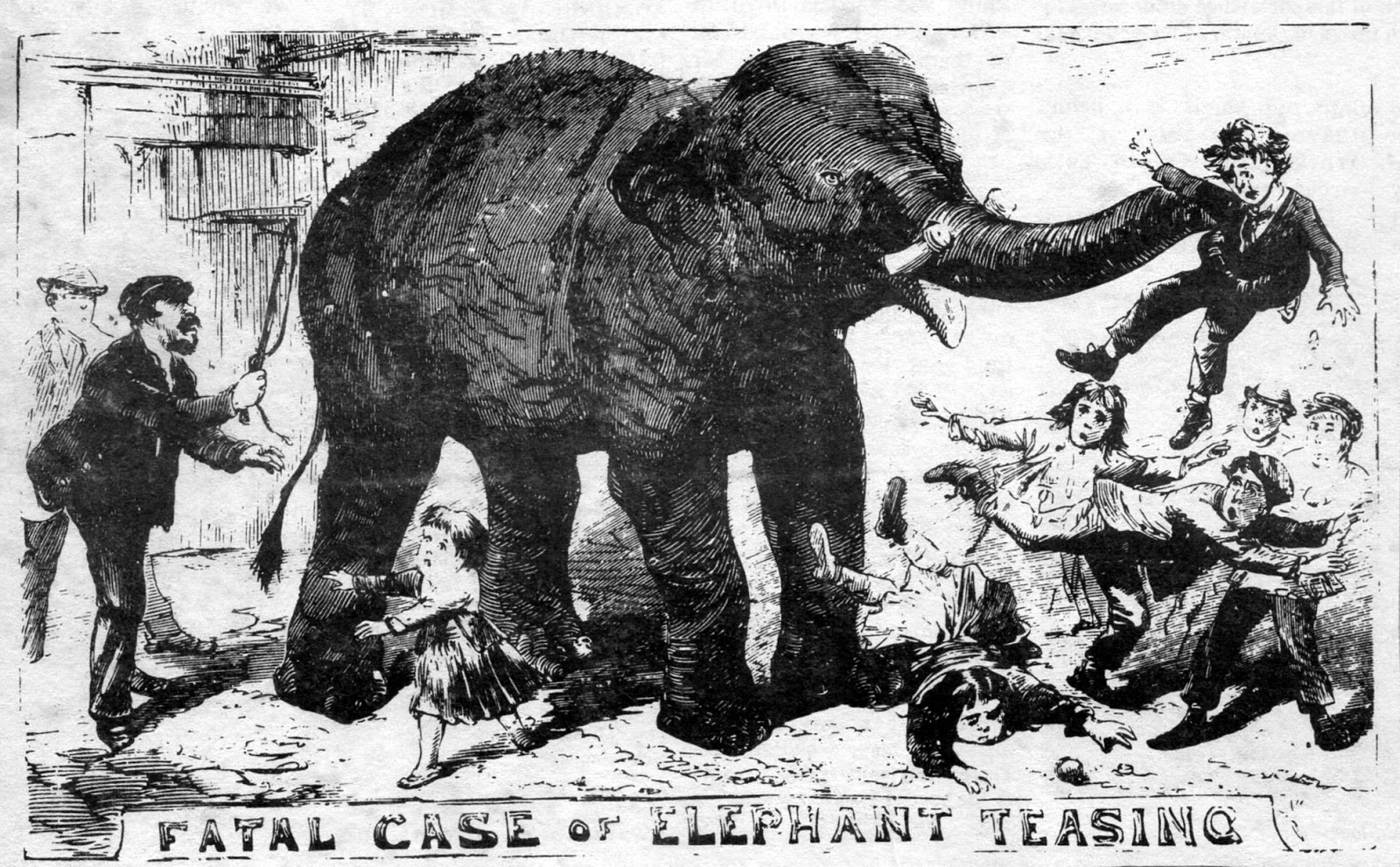
A Fatal Case of Elephant Teasing

The incident as depicted in The Police Illustrated News.
In the past it was common practice for the animals of travelling circuses to be lodged at local inns if the stables were large enough to accommodate them. In April 1872, Bostock and Wombwell’s circus was at Hanley for the Wakes and on the morning of Saturday 13th, a small group of children were feeding bread and nuts to one of the circus elephants in a passage leading to the Angel Inn. Its keeper, Thomas Hurley, was standing a few yards from the young female elephant, waiting for the key to the stable. He had driven the children away several times but they kept coming back and now while Hurley was distracted, one of the children, George Stanton, decided rather unwisely to play a prank on the elephant by feeding her a stone. Immediately and without warning, the elephant - normally a very gentle creature - went mad and lifting the boy in her trunk she crushed him against a wall with her head and tusks. Mr Hurley turned on hearing the screams from the children and shouted out, at which the elephant dropped the boy and he was carried away. George Stanton suffered wounds to his head and back and had been badly squeezed by the elephant. He died from his injuries on Sunday evening.
Reference: Staffordshire Bugle, February 1993

19 January 2018

The Curious Quadrupedal Company

For some weeks during the winter of 1852-1853, the locals in Hanley and Longton in the Potteries were treated to a number of visits from a Frenchman, Monsieur Desarais (or Desaris), with his troop of highly trained dogs and monkeys. His was one of many such travelling shows that trod the boards of the town halls or theatres up and down the country during the mid-nineteenth century. Often these shows were unsophisticated by modern tastes, but in an age where opportunities for popular entertainment were scarce, even the feeblest efforts were appreciated.

Monsieur Desarais’ show seems to have been better than most if reports of the time are anything to go by. In one short piece a reporter described exactly the performance he witnessed. After noting his astonishment at the animals’ performances and the skill of Monsieur Desarais as an animal trainer, the reporter continued.

This curious quadrupedal company, educated to a high pitch of perfection in the histrionic arts, and costumed to suit their respective characters successfully perform many of the conventionalities of daily domestic life. The supper scene, or monkey banquet, served by a monkey gentleman-in-waiting, a brother monkey the presiding genius of the table, with all the precision of fashionable conviviality, speech excepted. This was a rare treat in itself. A variety of curious evolutions followed, the dogs and monkeys habited as ladies and gentlemen waltzing to music, playing at leap-frog. A dog ascending and descending a double-ladder, with a monkey clinging to his back; one poor fellow industriously performed the rare treat of trundling a barrel up an inclined plane, wagging his tail to his master, apparently highly pleased at his success. The balancing tricks, by two dogs; and the performance of a solo by a “Jenny Lind” of the canine species, to an accompaniment on the violin followed by a hurdle race, in which the dogs were steeds and the monkeys, in full costume, were riders, caused roars of merriment.’

Overall, Monsieur Desarais’ sojourn in the Potteries was a great success, except, that is, for one unfortunate little incident in Shelton on Christmas Eve 1852. This was reported by the same paper, but far more glibly under the title, ‘Novel Mode of Evading Toll’.

The report described how Monsieur Desarais was passing through the Shelton toll gate in his small close carriage, drawn by four of his favourite dogs, when Mr Dixon, the gatekeeper came out of his house and demanded the toll. Monsieur Desarais refused to pay and a heated discussion ensued as to why the toll was necessary. Becoming angry and seeing that he was getting nowhere with the irate Frenchman, Mr Dixon seized some of Monsieur Desarais’ property in lieu of the toll, but this only made matters worse. Monsieur Desarais seeing his property confiscated in such an unceremonious manner yelled, “Then I’ll pay” and opened his carriage door as if to get the cash. No sooner was the door open than out leapt a large formidable-looking monkey, who as if instinctively protecting his master looked as if he were about to attack Mr Dixon. At that moment, though, the gatekeeper’s wife who had been keeping her eye on the altercation rushed out carrying a pistol. The sight of the gun so alarmed the monkey that he threw his tail around his owner’s neck and with a ferocious grin of horror shot back into the carriage. Whether the monkey’s actions had been choreographed by Monsieur Desarais we will never know, but he did not escape the toll keeper, for as the report concluded, ‘Monsieur, with his dogs and monkeys, left the toll-gate keeper to his reflections and his umbrella as a pledge.’

Reference: Staffordshire Potteries Telegraph, 1 January 1853

18 January 2018

Diary of a Bad Boy

On the morning of Wednesday 8 April 1908, the curious adventures of Moses Newell a somewhat grimy but innocent-looking 13 year old boy, were related to the Magistrates Mr J. P. Pratt and Mr P. Elliott at Fenton Police Court when he was brought before them on the charge of stealing a purse containing 11s, 4½d that belonged to his mother who lived at 17 Park Lane, Fenton.

Newell had left home on the previous Saturday and nothing had been seen of him until early that morning when he had been discovered sleeping in an ashpit behind Clarence Street, Fenton. Of the stolen money only 1s, 4d was found on him along with a small diary, some cigarettes and a few other items. The magistrates were left in no doubt as to the boy’s guilt or about what he had been doing with the money over the last four days, as the guileless youngster had been good enough to keep an account of his crime and his subsequent adventures in his diary, which were read out to the court. It was an exacting record of nothing less than a sustained eating and spending tour of the Potteries towns.

Saturday – Left home at dinner-time, having stolen a purse containing 11s, 4½d. Went to Hanley market, and had a twopenny potato pie, a cup of tea and a penny cake. Bought a purse and then two ha’penny books. Went into another cake shop and had another cup of tea, and stopped there until the theatre was open. Went to the Theatre Royal “Fourpenny Rush,” came back to Fenton, and slept in ashpit.

Sunday – Went to Longton and into cake shop. Had two penny herrings, a pen’orth of bread, a pint of tea. Cost me 4½d altogether. Went into icecream shop, and had a pen’orth of icecream, a ha’penny “cornet,” a penny drink, and then a wafer and another pen’orth of icecream, and a penny drink with icecream in it. On Sunday afternoon went into same cake shop, and had two-pen’orths of Yorkshire pudding and a cup of tea. Came back to the icecream shop and had some more icecream, and stayed playing. Went back to ashpit.

Monday – Got up at a quarter to seven, walked to Hanley, bought a ha’penny book, went on car to Burslem. Bought a purse. Went into cake shop, but they had nothing ready. Walked round the stalls, and had a pen’orth of toffee. Went into cake shop. Had a cup of tea. I fetched some coal for her and she gave me a penny, and I had another cup of tea and some sandwich. Bought two ha’penny books – “Dick Turpin” and “Robin Hood.” Went to Longton again. Cost me threepence going and threepence to go to the theatre. I had a bottle of “pop,” two oranges, and I paid for another boy threepence to go in and gave him twopence. He bought some “fags” and fetched me some.

Tuesday – Got up about seven. Got a car and went to Longton cake shop. Had two-pen’orth of meat, two-pen’orth of bread, and a pint of tea. I stopped in the cake shop until dinner-time. Had a penny bowl of soup and another pint of tea. Got a car to Hanley and thought I would go to theatre, but did not. I got a car again and went to Burslem. Went in another cake shop. Bought a penny bowl of soup, ha’porth of bread. I had a pen’orth of tea and went to Drill Hall (Poole’s entertainment), and paid twopence to go in. Bought a pen’orth of chocolate, ha’penny wafer, ha’penny glass of “beer,” and had another pen’orth of chocolate. When I came out I had a penny bottle of “burdock.” Got on the car to Hanley, and came to Fenton and got in the ashpit again.’

On the morning of Wednesday 8 April, though, young Newell’s spending spree came to an inglorious end when he was woken by a woman throwing ashes on him. Newell told the court that at first he thought it was a cat and then he thought it ‘as a fowl pecking him.’ The woman got hold of him and pulled him out of the ashpit and gave the boy a cup of tea. The authorities soon learned of his discovery and he was subsequently arrested by PC Ford for the theft of the purse.

After hearing the excerpts from Newell’s diary the magistrates remanded the boy for a week in order that a home might be found for him. A week later on 15 April, he was brought before Magistrates Mr Harold Wright and Mr A. Edwards at Longton on the charge of having wandered abroad without proper guardianship. His mother Fanny Williamson said that the lad was beyond control and that whenever he did something wrong he stayed away from home. The previous September and October he had disappeared for two months and could not be found. He had eventually come back, but had been away since then. On Saturday he ‘had been found in the pigeon place’, but later that day he had again absconded, this time with his mother’s purse and money. The woman was evidently at her wit’s end with the boy and the Stipendiary Magistrate Mr Wright said that the best thing to do was to send him to Werrington Industrial School until he was 16 years old. 

Little is known of Moses Newell’s later life, though after serving his sentence he moved out of the area; at the age of 16, in the 1911 census, he was recorded as working as a servant on a farm in Ruthin, Wales. Neither the Medal Rolls nor the Commonwealth War Graves records for World War One list his name, so this artful dodger seems to have managed to slip away again.

Reference: Staffordshire Sentinel, 8 April and 15 April 1908.